01
Persistent pain or reduced function
Back pain, leg pain or nerve symptoms that continue despite time, physiotherapy, medication or injections may prompt further review.
Spinal fusion and lumbar fusion can be discussed when back pain, nerve symptoms or spinal instability need careful specialist review. This site explains the procedure, the different fusion approaches and what patients can expect from consultation through recovery planning.
Spinal fusion is intended to stabilise a painful or unstable part of the spine by joining two or more vertebrae together. It is usually considered only after symptoms, imaging findings and the likely source of pain or nerve compression have been carefully reviewed.
In selected patients, lumbar fusion can form part of treatment for instability, spondylolisthesis, certain degenerative conditions, deformity or symptoms that relate to spinal movement and nerve compression. Different approaches are used depending on the spinal level, anatomy and the overall treatment objective.
Because spinal surgery decisions need care, patients often benefit from an explanation that covers what fusion may help with, what it may not address, and how recovery is typically planned around the individual rather than a template.

Patients may be referred for specialist opinion when symptoms persist, function is reduced, or spinal imaging raises questions about stability, nerve pressure or structural change.
Back pain, leg pain or nerve symptoms that continue despite time, physiotherapy, medication or injections may prompt further review.
Spondylolisthesis, degenerative change or movement-related pain can raise the question of whether stabilisation may need to be discussed.
Some patients seek reassurance, a second opinion or a consultant explanation of whether surgery is likely to be appropriate at all.
The decision for surgery depends on the whole clinical picture. Conditions commonly discussed on this site include:
Terminology can feel technical at first. These are some of the approaches patients most often encounter when discussing lumbar fusion.
Transforaminal lumbar interbody fusion is commonly discussed when access from the back and side of the spine helps address instability and nerve compression together.
Posterior lumbar interbody fusion approaches the spine from the back and may be considered when decompression and fusion are performed in the same operative field.
Anterior lumbar interbody fusion reaches the spine from the front and may allow disc work and restoration of disc height without direct dissection through the back muscles.
Lateral approaches reach the spine from the side and may be useful in selected cases involving alignment, disc height and indirect decompression goals.
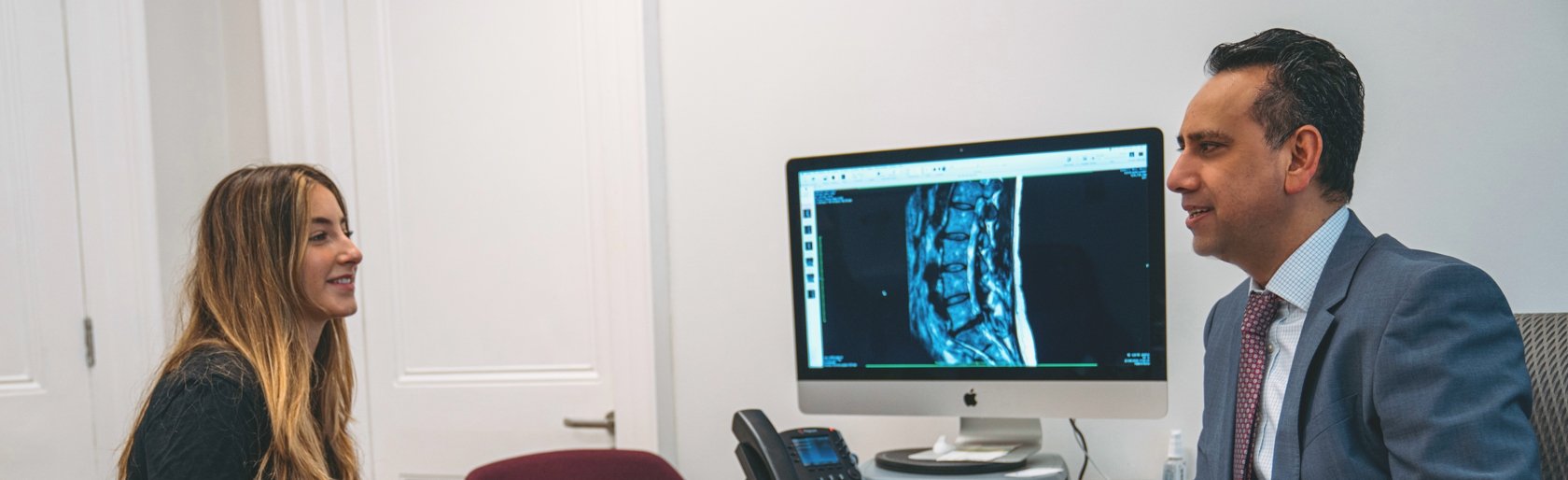
The first consultation is often about clarity rather than commitment. The aim is usually to understand symptoms properly, review investigations and explain the next sensible step.
Your consultation usually starts with the pattern of pain, leg symptoms, weakness, numbness, walking tolerance and previous treatments.
Imaging findings are considered alongside the symptoms, because surgery decisions should not be based on scans alone.
Where appropriate, discussion may include non-surgical measures, decompression alone, fusion options and the reasons for or against each route.
Approach choice is individual. The descriptions below are general summaries rather than promises of suitability for every patient.
In an anterior lumbar approach, the spine is reached from the front. This can create access for disc removal and cage placement while avoiding direct dissection through the back muscles.
Posterior approaches reach the spine from the back and may be used when decompression, instrumentation and fusion need to be carried out through the same pathway.
Patients often want a realistic idea of the early recovery period, return to activity and the need for follow-up. Recovery varies, so the most useful framing is usually what support and milestones are typically discussed rather than exact timelines.
Initial recovery usually focuses on wound care, mobilising safely, pain control and recognising what is expected after surgery.
Movement, activity progression and rehabilitation advice are generally tailored to the procedure and the patient’s starting point.
Follow-up helps assess symptom change, functional progress and whether imaging or further support is needed.
The wider service includes consultant spinal surgeons, deformity expertise, neurosurgical spine input and pain management support.
Consultant spinal surgeon associated with spinal surgery pathways and minimally invasive thinking.
View profile
Senior spinal expertise with recognised depth in scoliosis, deformity and complex spinal review.
View profile
Interventional pain expertise supporting patients who need broader discussion of non-surgical care, symptom control and peri-operative planning.
View profilePatients considering lumbar fusion often want an informed conversation first: whether surgery is appropriate, what the realistic goals are and how the pathway would usually be organised if an operation is advised.
Use the existing booking route for appointments. For urgent medical concerns outside office hours, patients should seek appropriate local urgent care.
19 Harley Street
London, W1G 9QJ
United Kingdom
+44 (0)203 973 8810
Monday to Friday: 8am - 6pm
Saturday: 9am - 1pm
Sunday: Closed
For urgent concerns outside office hours, please contact your GP or visit A&E.